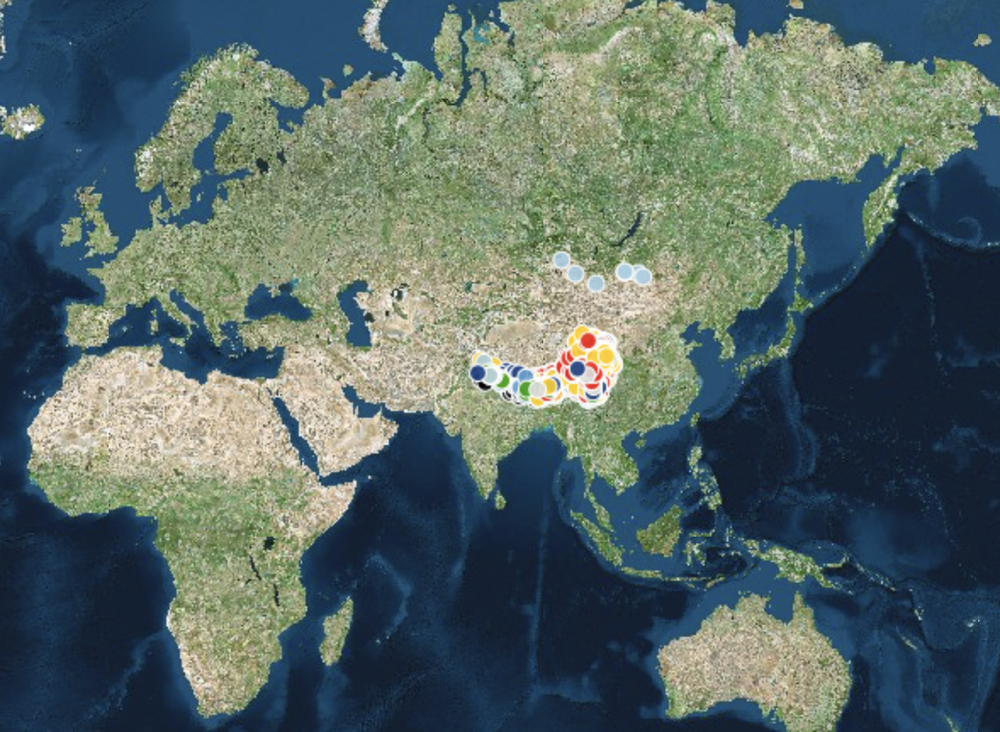
A Digital Humanities Project on Inner Asian Monasticism. This interactive map provides a database of 2,777 monasteries in Tibet. By pinning each monastery in different colors according to their religious affiliations, this map shows the diversity of Tibetan religious traditions and the spatial distributions of various religious affiliations.
The UBC DRH began as one of the flagship initiatives of the Cultural Evolution of Religion Research Consortium (CERC), based at the University of British Columbia in Vancouver. It now continues as an independent academic initiative, based at UBC but involving partners and collaborators from all over the world.
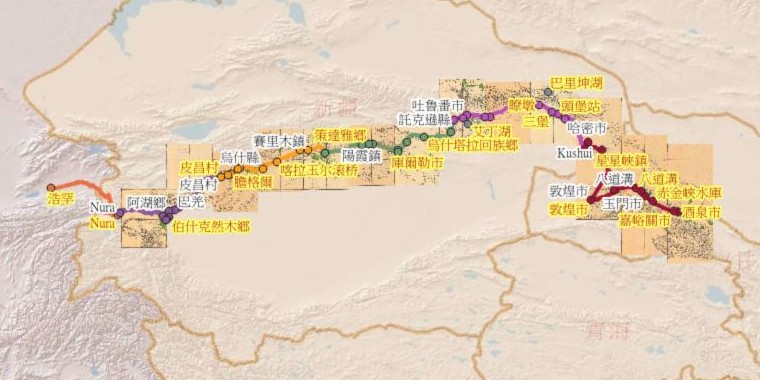
An interactive historical GIS of Suningga’s Wanli huijiang tu, a late eighteenth-century Qing route map of Xinjiang, built with the Center for GIS, RCSS, Academia Sinica. Users can overlay the map’s routes and place names on Qing historical maps, a 1:500,000 atlas of Hexi and Xinjiang, and Ming postal routes.