
Academia Sinica Key Breakthrough Seed Grant (2022)
The Qing Empire’s Reconstruction of Historical Memory and Ethnic Identity in Ming-Zheng Taiwan
This two-year project centers on the Manchu and Chinese manuscript copies of the Pingding haikou fanglüe 平定海寇方略 held by the Institute of History and Philology (IHP), Academia Sinica. Drawing on related multilingual Ming-Qing archives and sources from beyond China, it examines interactions between the Qing government and Ming-Zheng Taiwan from the perspective of historical memory and ethnic identity. By tracing how the Manchu and Chinese texts were compiled and revised, the project not only uncovers facts the Qing deliberately concealed in the course of its Taiwan campaigns, but also explores how the Qing court used war writing in Manchu and Chinese to reshape later generations’ historical memory of Taiwan and its ethnic relations. Approaching the relationship between Taiwan and the Qing from the plural perspectives of East Asian and world history, the project aims to offer a historically deep and culturally diverse point of reference for questions of collective memory and historical identity that Taiwanese society may face in the future.
、
Research Center for Humanities and Social Sciences, Academia Sinica
January 1, 2023 – December 31, 2024
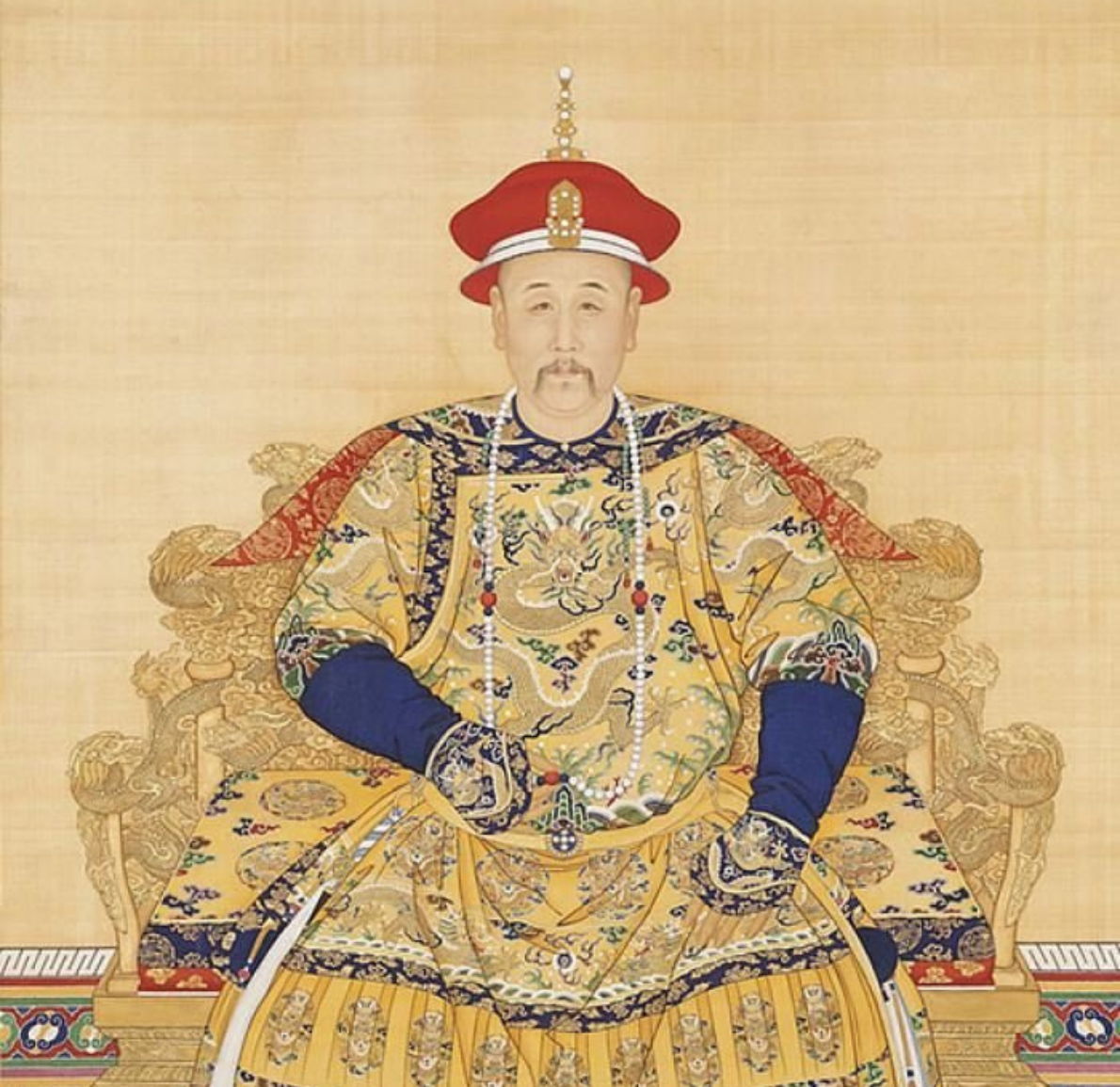
Academia Sinica Key Breakthrough Seed Grant (2022)
The Qing Empire’s Reconstruction of Historical Memory and Ethnic Identity in Ming-Zheng Taiwan
、
Research Center for Humanities and Social Sciences, Academia Sinica
January 1, 2023 – December 31, 2024
This two-year project centers on the Manchu and Chinese manuscript copies of the Pingding haikou fanglüe 平定海寇方略 held by the Institute of History and Philology (IHP), Academia Sinica. Drawing on related multilingual Ming-Qing archives and sources from beyond China, it examines interactions between the Qing government and Ming-Zheng Taiwan from the perspective of historical memory and ethnic identity. By tracing how the Manchu and Chinese texts were compiled and revised, the project not only uncovers facts the Qing deliberately concealed in the course of its Taiwan campaigns, but also explores how the Qing court used war writing in Manchu and Chinese to reshape later generations’ historical memory of Taiwan and its ethnic relations. Approaching the relationship between Taiwan and the Qing from the plural perspectives of East Asian and world history, the project aims to offer a historically deep and culturally diverse point of reference for questions of collective memory and historical identity that Taiwanese society may face in the future.
Learn About Our Research
The relationship between the Qing and Taiwan has long been contested because of the limits of historical perspectives and sources. Through new sources such as the Manchu and Chinese texts of the Pingding haikou fanglüe held by the IHP, this project moves beyond Sinocentric narratives to re-examine Qing–Taiwan relations in East Asian and world-historical contexts, opening plural historical perspectives for Taiwanese society. Using historical and philological methods to compare Manchu and Chinese archives, it builds on the established strength of Taiwan’s Qing-history scholarship in archival research while engaging the forefront of European and American scholarship. Emphasizing interdisciplinary integration, it combines textual historical narrative with GIS visualization and uses AI to explore the possibilities of digital-humanities research on Manchu and Chinese sources.
Focusing on Manchu sources, world-historical perspectives, and digital-humanities methods, the project seeks to offer plural historical views of Qing–Taiwan relations and a point of reference for Taiwanese society’s reflections on collective memory and historical identity. Its results will be submitted to leading international journals to raise the visibility of Taiwanese scholarship.
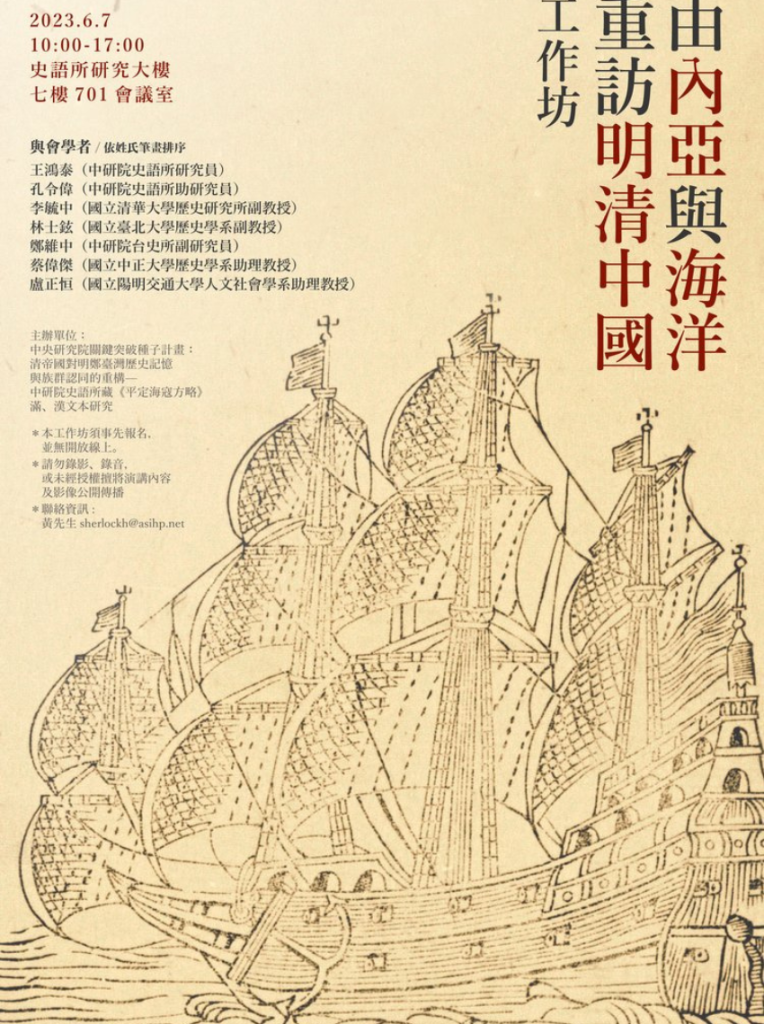
2023/06/07 Workshop
Revisiting Ming-Qing China through Inner Asia and the Maritime World: A Workshop
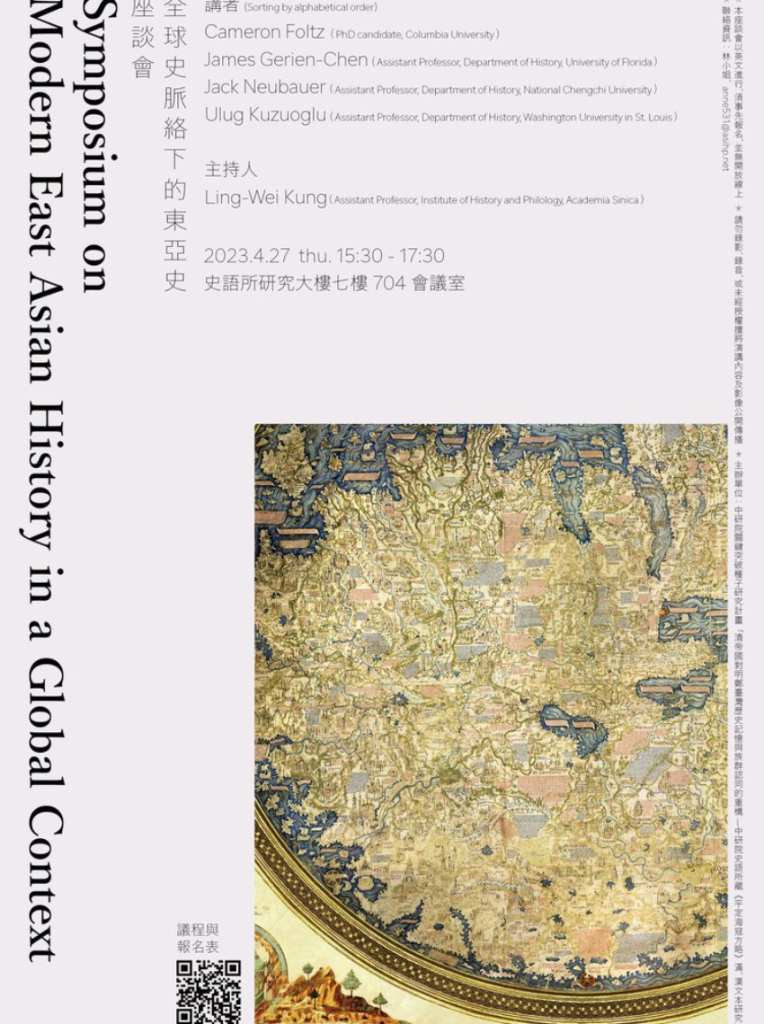
2023/04/27 Roundtable
Modern East Asian history in a global context
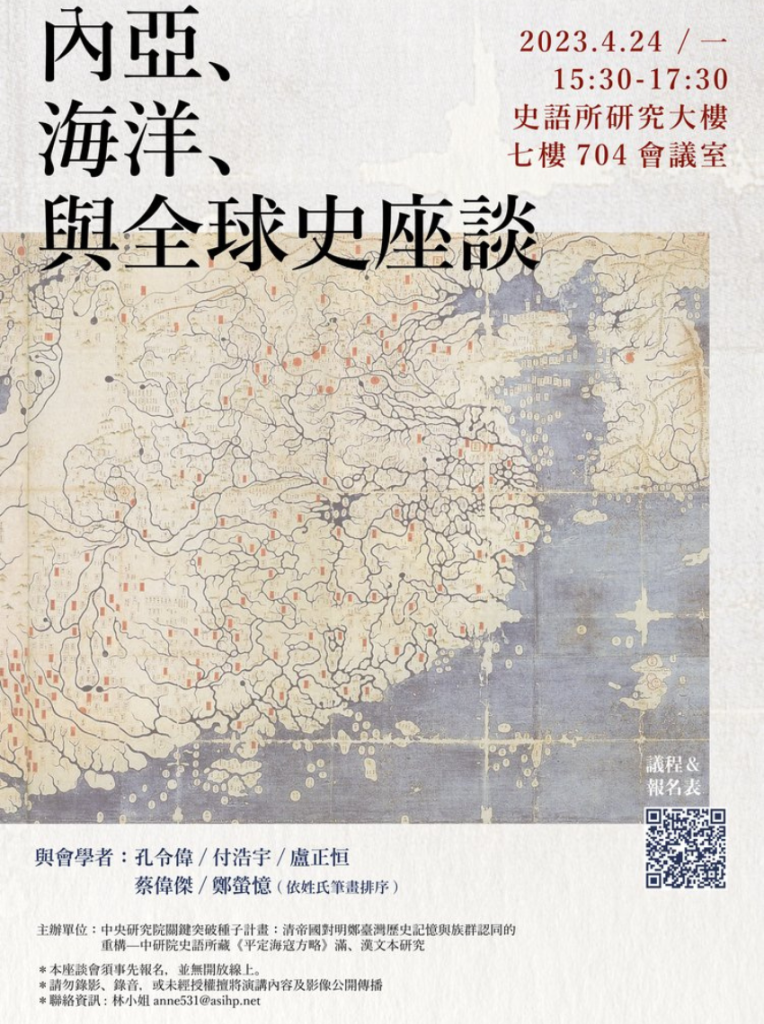
2023/04/24 Roundtable
Inner Asia, the Maritime World, and Global History

2023/02/22 Keynote Lecture
Two Manchu Terms for the Qing Emperor: han (汗) and ejen (厄真)
Principal
Investigator

Ling-Wei Kung
Assistant Research Fellow, Institute of History and Philology, Academia Sinica
Research fields: Yuan, Ming, and Qing China and Eurasian exchange; history of science and technology; global history; Inner Asian philology
Co-Principal
Investigator

Richard Tzong-Han Tsai
Research Fellow, Research Center for Humanities and Social Sciences, Academia Sinica
Research fields: natural language processing, dialogue systems, deep learning, biomedical text mining, sentiment analysis, cross-lingual processing, digital humanities